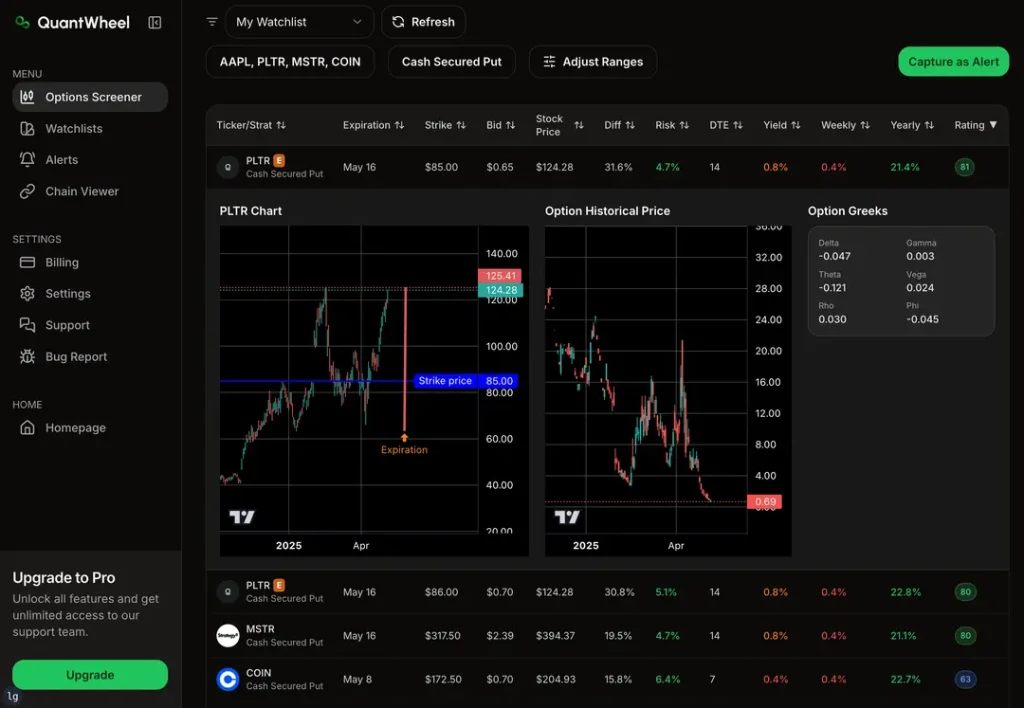
The wheel strategy is a popular options trading method that generates income by selling puts and calls in a cycle. Many traders use this approach to earn steady cash flow while potentially acquiring stocks at lower prices. It works best in sideways or slightly bullish markets.
This strategy involves three main steps: selling cash-secured puts, getting assigned shares if the stock drops, then selling covered calls against those shares. You repeat this process like a wheel, which gives the strategy its name. The goal is to collect premium income at each step while managing risk.
The wheel strategy appeals to income-focused traders because it can produce regular cash flow. You don’t need to predict market direction perfectly to succeed. Instead, you focus on stocks you wouldn’t mind owning long-term and collect premium payments along the way.
How the Wheel Strategy Works
The wheel strategy combines selling put options with covered calls to generate income from stocks you want to own. This approach works through a repeating cycle that can produce cash flow whether you hold shares or not.
What Is the Wheel Strategy?
The wheel strategy is an options trading method that creates income through two main steps. First, you sell cash-secured put options on stocks you would buy at a lower price. Second, if you get assigned shares, you sell covered calls against those shares.
This process forms a “wheel” because it repeats continuously. You either collect premium from puts or own shares while selling calls. The strategy works best when you pick quality stocks that trade sideways or move up slowly.
Many traders use this approach to lower their cost basis on stocks they want to hold long-term. You earn money from option premiums while waiting to buy shares at your target price.
Step-by-Step Process of the Wheel Approach
Phase 1: Selling Cash-Secured Puts
Start by picking a stock you want to own. Sell put options with a strike price below the current stock price. You need enough cash in your account to buy 100 shares per contract.
If the stock stays above your strike price, the put expires worthless. You keep the premium and can sell another put option. This continues until you get assigned shares.
Phase 2: Assignment and Share Ownership
When the stock price drops below your strike price, you get assigned 100 shares per contract. You now own the stock at your chosen strike price minus the premium you collected.
Phase 3: Selling Covered Calls
Once you own shares, sell call options against them. Pick a strike price above your total cost basis. If the calls expire worthless, you keep the premium and sell more calls.
If the stock price rises above your call strike, your shares get called away. You profit from the stock price increase plus all the premiums collected.
Key Criteria for Stock Selection
Choose stocks with high implied volatility to earn better premiums. Look for companies with strong fundamentals that you would hold for months or years. Avoid stocks that might face major problems or bankruptcy.
Pick stocks that trade between $20 and $200 per share. Very cheap stocks often have serious issues. Very expensive stocks require too much capital per contract.
Select stocks with weekly or monthly options that have good trading volume. Poor liquidity makes it hard to enter and exit positions at fair prices.
Focus on stocks that tend to trade sideways or move up gradually. Highly volatile stocks can cause large losses if they drop quickly after assignment.
Assignment and Exercise Explained
Assignment happens when the option buyer uses their right to buy or sell shares. For put options, you must buy 100 shares at the strike price when assigned. This usually occurs when the stock price falls below your strike price at expiration.
Exercise refers to when you choose to use an option contract. Most traders let options expire or sell them before expiration rather than exercise them.
Assignment is automatic and happens after market close on expiration day. You will see the shares in your account the next trading day. The cash used to buy the shares comes from the money you set aside when selling the put option.
Assignment on covered calls means your shares get sold at the strike price. You keep all dividends received while holding the shares plus the call premium.
Optimizing and Managing the Wheel Strategy
Success with the wheel strategy depends on careful risk management, maximizing premium income, and timing your trades based on market conditions. A complete understanding of how these elements work together helps you build consistent returns while protecting your capital.
Risk Management and Loss Mitigation
Risk management forms the foundation of wheel strategy success. You must set clear rules before starting any wheel cycle.
Position sizing protects your capital from major losses. Never risk more than 5% of your total account on any single wheel trade. This prevents one bad stock from destroying your portfolio.
Choose stocks you actually want to own. Research the company’s financial health, debt levels, and business model. Strong companies with steady earnings help reduce your risk of permanent losses.
Set stop-loss rules for your holdings. If a stock drops 20-30% below your cost basis, consider selling and moving to a different underlying. This prevents small losses from becoming large ones.
Diversification across sectors reduces concentration risk. Don’t run wheel strategies on three tech stocks at once. Spread your trades across different industries like healthcare, consumer goods, and utilities.
Monitor implied volatility levels. High volatility increases premium income but also signals higher risk. Avoid stocks with volatility above 50% unless you understand the specific risks involved.
Maximizing Income and Premiums
Premium collection drives your wheel strategy returns. Focus on strike prices that offer the best risk-reward balance.
Target put options with 30-45 days to expiration. This timeframe captures optimal time decay while giving you flexibility to adjust positions. Weekly options decay too fast and create unnecessary stress.
Sell puts at strike prices 5-10% below the current stock price. This gives you a safety buffer while still collecting meaningful premiums. Strikes too far out-of-the-money pay very little.
Roll positions when they move against you. If your short put goes in-the-money with 10+ days left, roll to a later expiration date. This extends time for the stock to recover and generates additional premium.
When assigned shares, start selling covered calls immediately. Set call strikes 2-5% above your cost basis to ensure profits if called away. Don’t get greedy with call strike selection.
Consider dividend-paying stocks for additional income. Quarterly dividends boost your total returns while you hold shares during the covered call phase.
Analyzing Market Conditions and Timing
Market conditions directly impact wheel strategy performance. You need different approaches for bull, bear, and sideways markets.
Bull markets favor aggressive strike selection. You can sell puts closer to current stock prices since upward momentum reduces assignment risk. Focus on growth stocks with strong momentum.
Bear markets require defensive positioning. Sell puts further out-of-the-money and focus on dividend stocks or defensive sectors. Accept lower premiums in exchange for reduced assignment risk.
Sideways markets create ideal wheel conditions. Stocks trade in ranges, making both put and call sides profitable. Target stocks with clear support and resistance levels.
Earnings announcements create opportunities and risks. Implied volatility spikes before earnings, increasing premium income. However, unexpected results can cause large price moves against your positions.
Use technical analysis to time entries. Sell puts when stocks approach support levels and implied volatility is elevated. Avoid selling puts after major breakdowns or during strong downtrends.
Example of a Complete Wheel Cycle
Here’s how a complete wheel cycle works with XYZ stock trading at $50.
Week 1: Sell one put contract with $45 strike expiring in 35 days. Collect $150 premium. Your breakeven point becomes $43.50 ($45 – $1.50 premium).
Week 5: XYZ drops to $44 and you get assigned 100 shares at $45. Your actual cost basis is $43.50 after premium collected.
Week 6: Start selling covered calls against your 100 shares. Sell $47 call for $100 premium, lowering your cost basis to $42.50.
Week 9: XYZ recovers to $48 and your call gets assigned. You sell shares at $47 strike price.
Total profit: $450 ($150 put premium + $100 call premium + $200 capital gain from $42.50 cost basis to $47 sale price).
This cycle generated 10.6% return on the $4,250 capital at risk over nine weeks.